
Prof Zakes Mda on the family, faith and exile that shaped one of South Africa’s most remembered political figures.
Katlego Sekhu

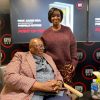
More than three decades after his assassination, Chris Hani remains one of South Africa’s most influential and widely remembered political figures. In front of a live studio audience, Phemelo Motene was joined on Point of View by acclaimed author Prof Zakes Mda for the launch of his new book, Chris Hani: A Life of Courage and Compassion.
A Beetle in Mafeteng
Prof Mda’s connection to Hani is personal. In 1974, he was among those in Mafeteng, Lesotho, helping pack the boot of a Beetle belonging to Hani’s father, Gilbert.
He was there because of exile, though not his own. “It was not really my exile. It was my father’s exile,” he says. His father, A.P. Mda, a former ANC Youth League president who went on to help form the PAC, was exiled to Lesotho in 1963, where refugee families from different movements lived side by side. “We all lived there as a community, irrespective of political parties to which we belonged.”
By then, Hani was 32 and had already fought in the Wankie Campaign, in what is now Zimbabwe.
From altar boy to activist
The book traces the people who shaped him. Gilbert Hani was a freedom fighter in his own right, and Hani’s uncle Milton was a committed communist. As a boy, Hani was an altar boy at a Catholic mission school and hoped to become a priest, until his father said no. “And of course, he couldn’t defy his father.”
At Lovedale, he joined the youth wing of the Non-European Unity Movement, but grew disillusioned with a group he felt preferred debating political theory. He wanted activism “out there with the people, with the masses,” Prof Mda says.
Lovedale is also where Hani crossed paths with a young Thabo Mbeki. Some have suggested a rivalry, but Prof Mda found none. “I didn’t find any example of rivalry in action. What I found was that, yes, there were different approaches.” Mbeki was a quiet organiser, while Hani was louder and “viewed as more radical, more militant,” which drew many students to him.
The Lesotho years
In 1974, the movement sent Hani to Lesotho to establish what was known as the Lesotho machinery. His wife, Limpho Hani, a Lesotho citizen, was active in moving young people out of South Africa. After 1976, she was arrested in the Free State with a group that included Prof Mda’s own younger brother.
Piecing this story together meant leaning on the memories of those still alive, because, as Prof Mda puts it, “very few people were keeping records those days.”
To hear Prof Zakes Mda in conversation with Phemelo Motene, listen to the podcast.
READ NEXT: