Speaking on Kaya 959’s Point of View, Zille said she would rather remain in opposition than be part of a government that cannot govern effectively.
By Mapaballo Borotho
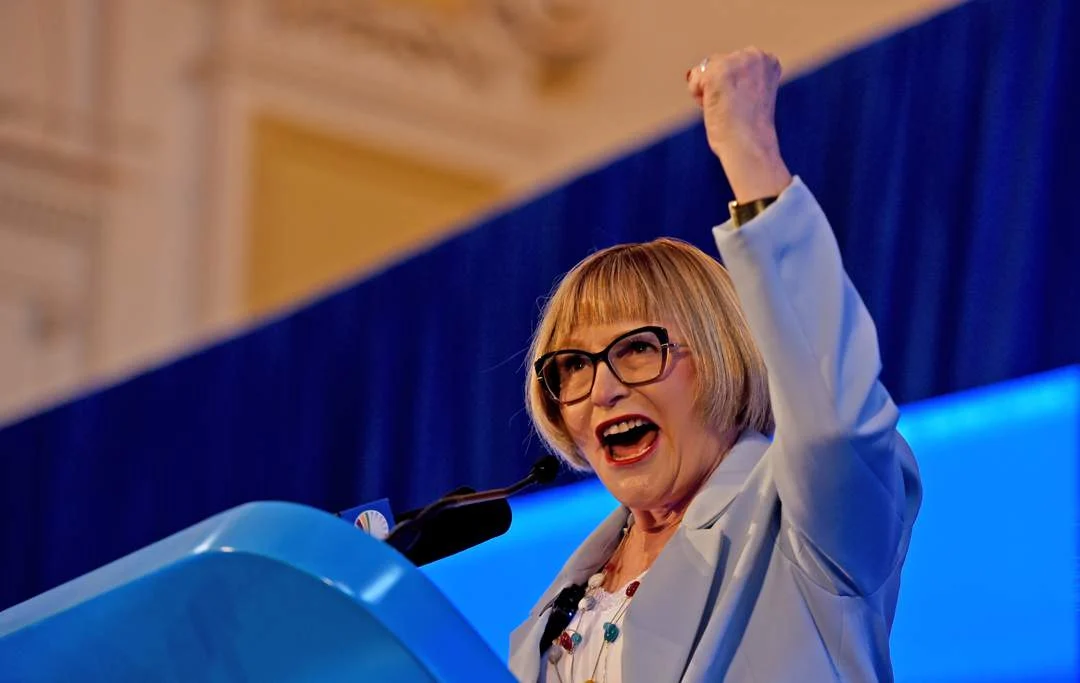
Democratic Alliance (DA) Johannesburg mayoral candidate Helen Zille says instability in local government is a consequence of choices made by voters.
This comes as metros across Gauteng continue to experience instability amid coalition governments, with political parties having different values, methods of working and priorities.
Coalition government has become increasingly prominent in local government, particularly where no single party secures an outright majority.
South Africans are set to go to the polls on 4 November 2026 to participate in this year’s local government elections.
As the election approaches, the question of which party will govern each metro and whether some metros will once again be governed through coalitions remains a key issue.
Zille was speaking to Phemelo Motene on Kaya 959’s Point of View ahead of the local government elections.
Coalition government
Zille says instability is a consequence of votes being split between smaller parties.
“Instability is the consequence of splitting all the votes between all the smaller parties. And inevitably those parties tend to gravitate towards the ANC and put the ANC back in power. Gayton McKenzie did the whole city a big favour by saying that they are already negotiating a coalition between the ANC, EFF, MK, PA and other smaller parties to continue the current coalition of chaos,” she said.
Zille says voters would want to avert that and consolidate their votes behind the DA.
She says she would rather remain in opposition than be part of a coalition that does not govern well.
“When you get into government, you need to govern well, and that means you have to be able to implement your plan and take the tough decisions. If you have to negotiate from council meeting to council meeting to ward off motions of no confidence and to get stuff through, it is almost impossible. So I always say I’d rather be in opposition than in government and not be able to govern properly.”
Zille says being part of a government that covers up corruption and extortion does not make sense.
Corruption is syndicated
Zille says there are different corruption syndicates working against each other in Johannesburg.
“Johannesburg has tragically become different corrupt networks competing against each other for access to resources, and I believe that when you’re cleaning our corruption, you start sweeping up the staircase from the top and that is what we will do.”
She says there has been extensive research into where corruption lies and how it works, while thanking whistleblowers who have come forward to highlight corruption in Johannesburg.
“One of the first things we would have to do is digitise the billing system because a lot of the corruption stems from the fact that the billing system is not digitised and therefore people can interfere with spreadsheets, change the numbers, change the meters and extort people.”
The South African Police Service (SAPS) also came under scrutiny, with Zille saying she hopes the Madlanga Commission of Inquiry will help uncover corruption involving senior police officials, ministers and politicians.
“People need to understand that corruption will be uncovered and does not pay.”
She says if the top ranks are clean, straightforward and formidable, it becomes easier to address corruption throughout the rest of the structure.
Failing infrastructure in Joburg
Zille says Johannesburg, particularly the Central Business District (CBD), is an example of infrastructure that continues to deteriorate.
Buildings are dilapidated, while some police stations and hospitals are not adequately resourced and equipped, affecting vulnerable South Africans who rely on these institutions daily.
Zille says Joburg spent R5 billion on infrastructure in the last financial year against an R8 billion budget.
“Joburg has been going back on infrastructure year after year and some of my videos have tried to show that. One of the very worst that we saw was what I called the Niagara Falls of sewage, which was on the other side of Nancefield; all the sewage coming from Soweto, Eldorado Park and other suburbs falls into that particular sewage farm.”
She says when the government is dealing with infrastructure problems on that scale, an enormous amount of money will have to be spent.
Zille says failing infrastructure has real-life consequences for thousands of people.
Hijacked buildings
Zille says buildings that have been abandoned by their owners due to debt owed to the City will be sold in execution of the debt.
She says hijacked city buildings will also need to be addressed.
“We have to create what we call temporary relocation areas for people. We will do that in the quickest possible way that is compatible with a humane and decent standard. We would get court orders to evacuate those buildings and we will do that with Home Affairs so that anybody who’s illegally in South Africa would have to be deported.”
She says the DA would deal with hijacked buildings one by one.
Listen to the podcast for the full conversation on the DA’s 2026 local government manifesto and its proposals for municipal governance, water, electricity, public safety and local economic development.
Kaya 959 podcasts are available to download.
READ NEXT: