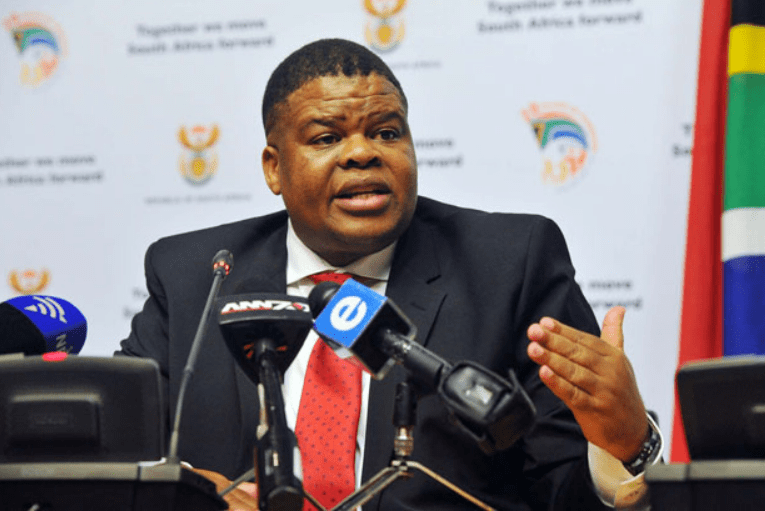
Deputy Minister David Mahlobo explains how government is dealing with municipal water debt.
Department of water & sanitation is reportedly owed R17.4bn by municipalities and water boards.
This was revealed by Water & sanitation minister Senzo Mchunu at the National Assembly in his budget vote speech Tuesday.
He said that in February municipalities owed water boards R16.7bn, while municipalities and the water boards owed the department (which has its own water trading entity) R17.4bn.
Also Read: Gift of the Givers R60 million upgrade to fire struck Charlotte Maxeke Hospital complete
Point of View with Phemelo Motene spoke to Water and Sanitation Deputy Minister David Mahlobo speaks to Phemelo about how government is dealing with municipal water debt.
LISTEN TO THE FULL CONVERSATION HERE:
Outlining issues that lead to the increasing debt owed
The issue about municipality’s inability to collect revenue is on a basis of a number of issues. One of the issue is structural; the funding by the government or the fiscal regime means that the budget goes to national, then provincial, and then goes to municipalities, this is a problem we need to look at over some time.
Secondly, there’s an issue that our assumption as local government is that local citizens should be able to able to pay for themselves, however there are certain citizens are unable to pay. This is despite that those who are unable to pay by supported by government through security system, there’s free basic water, there’s free basic electricity.
On Government’s planned intervention
“The Deputy President has been assigned by the President to look at various measures working with various ministries including Treasury and SALGA to look at a situation where there is an escalation of debt both for water and electricity and to find mechanism to deal with that.
Biggest problem with municipalities
“Our own experience has been that municipalities must be able to know that the biggest income generators, in term of municipal revenue in the main is electricity and water. One of the biggest problems they do in our own case is that the money that they money being generated for sales of water, they don’t bring it to fix the water infrastructure.”
“Thereby not protecting the hen that lays the golden egg, which leads to water losses and issues of water failure. We are looking at a legislation to actually compel them to do so.”
READ NEXT: How do you protect your stuff in places where you share space with others?




![[WATCH PODCAST] Mr. Mercedes drops highly anticipated project, joining forces with Thabo Smol and Spice Drums](https://www.kaya959.co.za/wp-content/uploads/2026/10/KAYA-959-THUMBNAILS-79-100x100.png)
![[WATCH PODCAST] Tumisho Masha commands the screen as colonel Jack Phatudi in M-Net’s new must-watch series](https://www.kaya959.co.za/wp-content/uploads/2026/10/KAYA-959-THUMBNAILS-78-100x100.png)