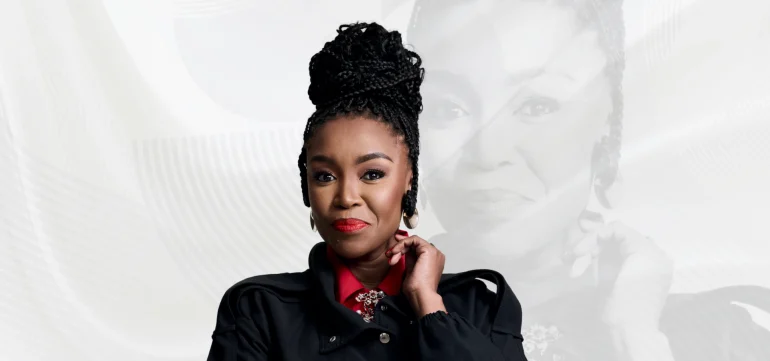
The SEVEN founder tells Fresh and Thato how every piece travels from a quiet moment of imagination to the hands of skilled artisans.
Katlego Sekhu
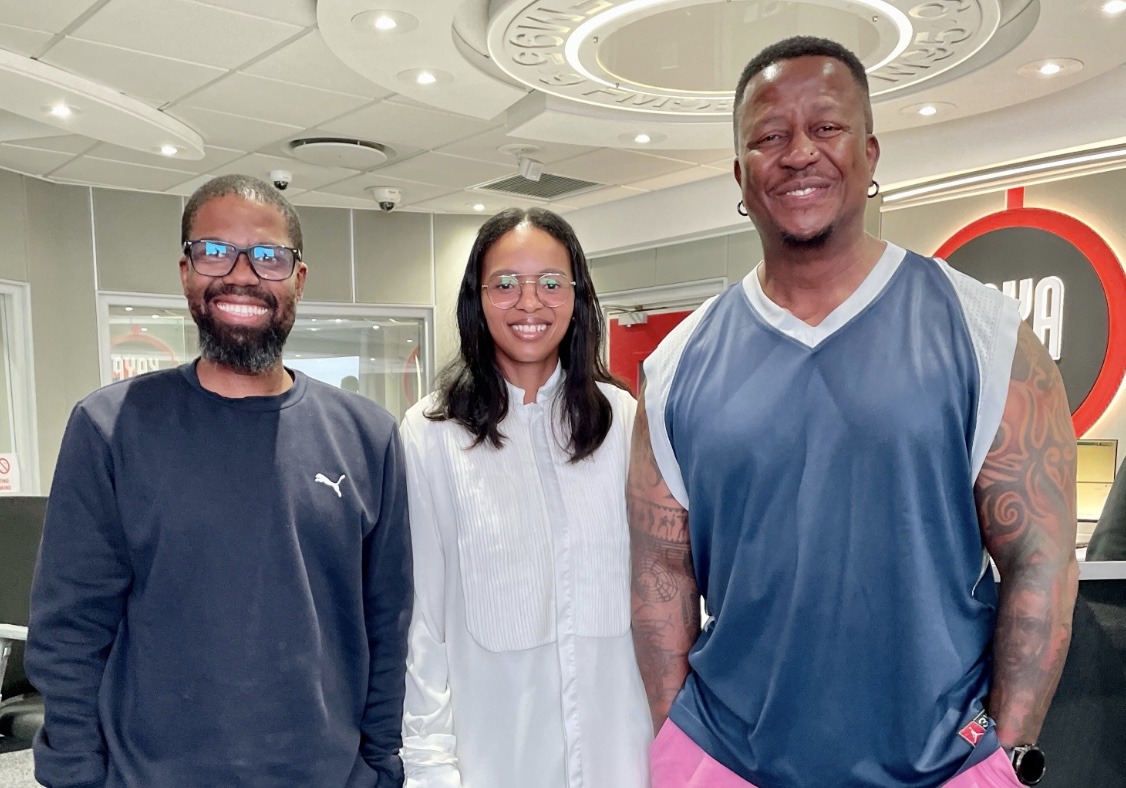
Some people look at the sensible option of a normal job and say no thank you. Sithasolwazi Mona is one of them. On Creator’s Corner recently, DJ Fresh and Thato Mataboge sat down with the founder and Head Creative Director of SEVEN, The Seven Store, a luxury brand creating small-batch, handcrafted leather pieces from locally sourced materials. Because she works with the natural skins available to her, some pieces don’t come back once they sell out.
Mona describes herself as a maker of things and a builder of brands. The name SEVEN carries a meaning she holds close. “Seven spiritually means it’s complete. It is done. It holds a lot of spiritual depth,” she said.
The idea came to her early in the process of building the brand, during a conversation with her maker. “The idea came to me almost like someone was whispering in my ear as to what I need to do,” she said. She built SEVEN as an ode to her maker, and as something to come back to whenever she needs to check that she’s on the right track.
It Started in Her Mother’s Wardrobe
Her eye for beautiful things goes back to childhood. Her mother travelled a lot and always brought back incredible pieces from around the world.
“As a little girl, I would go into my mother’s wardrobe and wear her shoes, her bags, her jewellery, all her accessories,” she said. When she chose a creative path as an adult, that wardrobe became her benchmark. “I then decided that I am going to create the things that I see in my imagination and to allow them to live up to the standards of the pieces that I saw in my mother’s wardrobe.”
From Imagination to the Shelf
Every SEVEN piece starts in Mona’s mind. “I have to sit in a place of peace in order for the ideas to come to me,” she said. Sometimes she sees a full outfit, sometimes just a detail or the shape of a bag.
From there, the idea becomes a sketch. Her craftspeople turn it into a 2D prototype, then 3D, then a physical product. Then comes testing, and Mona does it herself. “I physically wear whatever we’ve created. I’ll stress test it. I’ll ensure that it holds. I’ll ensure that nothing breaks.”
Production is the stage she rates most important. Skilled artisans make each piece one by one, by hand, from beginning to end. A final quality check follows, and only then does a piece reach the shelf.
“And that entire process is essentially how we define luxury,” she said. Each piece comes with a lifetime guarantee, and SEVEN makes products meant to be passed down from generation to generation. Owners still have a part to play, though. The guarantee holds “provided that you also take care of it as the custodian of that product.”
Naturally, the hosts wanted to know whether a SEVEN bag could survive the classic mom-handbag treatment. Mona was unbothered. “Leather is durable. It’s a skin at the end of the day, and it can hold a lot.”
Sold Out Means Sold Out
How does a businesswoman make peace with a design selling out for good? Easily, it turns out. “I’m never short of ideas. So I’m not worried if something sells out,” she said. Scarcity, she argues, adds value to the piece. “Once it’s done, it’s done. We go into the next thing.”
When something goes wrong along the way, the team doesn’t start over. They go back one stage, work out what went wrong and how to make it stronger, then carry on. The goal is a product that needs no sales pitch. “We can put in front of someone and walk away. It’ll speak for itself.”
Meet THE ALU
THE ALU, SEVEN’s latest release, is a handbag made for everyday wear. “We make pieces to be lived in,” Mona said. “Fashion is fun. And I think that that’s something that we should never, you know, take away.”
THE ALU comes in calfskin, printed croc and ostrich leg leather, in two sizes: a larger one for travel and a smaller one for every day. Mona counts it among her favourite styles because it can go anywhere.
Some of the Best Hands in the World
When the conversation turned to African luxury versus international luxury, Mona spoke about skill. “We have some of the best hands in the world. And we need to appreciate that more.”
SEVEN, she explained, is building an incubator for specialised craftspeople. The aim is to bring manufacturing and production back at a larger but intentional scale, so these skills are preserved. She pointed to the international luxury houses, which have kept their craft alive for over a century, long after their founders. SEVEN is working from that blueprint. Mona said South Africa is in a skills crisis: the country was once a manufacturing hub for the world and has since lost over 120,000 jobs in the textile industry.
SEVEN is available online at thesevenstore.co and on Instagram at @thesevenstore.co. The brand has also just opened its atelier in Parktown North, Johannesburg. It will serve as SEVEN’s creative hub and studio, where pieces can be viewed in a more experiential setting by appointment.
READ NEXT:
![[EXCLUSIVE] Inside the creative vision of the legendary Scorpion Kings Concert](https://www.kaya959.co.za/wp-content/uploads/2026/10/WhatsApp-Image-2026-10-05-at-12.54.14-780x1170.jpeg)
![[EXCLUSIVE] Inside the creative vision of the legendary Scorpion Kings Concert](https://www.kaya959.co.za/wp-content/uploads/2026/10/WhatsApp-Image-2026-10-05-at-12.54.14-100x100.jpeg)