
The apartheid activist was abducted and tortured by security police in 1983, but the circumstances surrounding her disappearance and death remain unresolved.
By Mapaballo Borotho
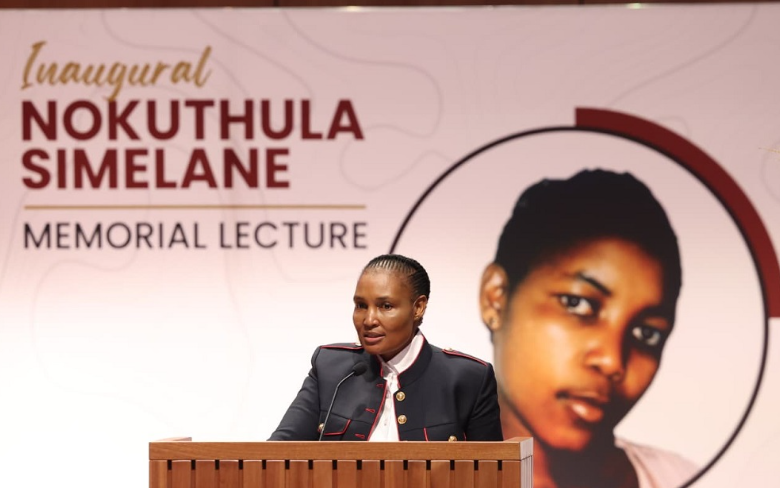
More than 40 years after apartheid activist Nokuthula Simelane was abducted and disappeared, her family continues to seek answers and accountability.
Simelane’s story was remembered at a gathering at the University of Mpumalanga in Mbombela on Thursday, 3 September 2026, where her family reflected on her life, disappearance and enduring legacy.
Phemelo Motene spoke to Nokuthula’s younger sister, Human Settlements Minister Thembi Simelane, on Kaya 959’s Point of View.
Thembi says she has had to find a balance between fighting for justice and celebrating the life of her sister.
“I must give credit to my friends because they are the ones who have been pushing me to find balance in fighting for justice and the truth when it comes to my sister’s case, while celebrating and honouring her legacy at the same time,” she said.
Nokuthula, an ANC activist, was abducted and tortured by members of the apartheid-era Security Branch of the South African Police in 1983.
She was just 23 years old at the time and was only weeks away from graduating from the University of Swaziland, now the University of Eswatini, where she was studying for a Bachelor of Administration in Social Science, majoring in Public Administration.
“She had just turned 23. She disappeared just a couple of days after her 23rd birthday. When she disappeared, she was going for graduation in two or three weeks. She had already received her scholarship,” Thembi said.
She described her sister as an extraordinary young woman and said she wants to ensure that Nokuthula’s life is remembered beyond the circumstances surrounding her disappearance.
“I really believe that she was just a girl who was simply amazing and extraordinary. This is what I have been missing all along, celebrating who she was rather than what she was not afforded.”
The search for justice
In 1996, a police docket for murder and kidnapping was opened.
A year later, several former Security Branch members applied for amnesty before the Truth and Reconciliation Commission’s Amnesty Committee in connection with Simelane’s abduction, torture and other related crimes.
In 2001, the Amnesty Committee granted amnesty to those who had applied in relation to her abduction.
However, none of the perpetrators applied for amnesty for her alleged murder.
In 2013, 30 years after Simelane’s disappearance, her family requested an inquest into her death. The National Prosecuting Authority rejected the request, citing an incomplete investigation.
A death certificate for Simelane was eventually issued on 21 August 2019.
Despite the passage of more than four decades, questions surrounding what happened to Simelane remain.
‘I have forgiven them’
Thembi says she has forgiven some of the people involved in the brutality surrounding her sister’s disappearance.
She says encounters with some of the former apartheid-era operatives gave her insight into the impact the apartheid system had on those who participated in it.
“As much as I was young when my sister left us, I saw sincerity in some of these people and I think that is why the judges were also able to see sincerity in them.”
She says her search for answers has at times brought her face-to-face with people who were involved in her sister’s case.
“In the journey of really trying to find some more of the answers, I found myself looking for them again and whenever I found them, they would break down and I really started to see what apartheid did to black men and how much it broke them.”
Simelane’s case remains a painful reminder of how the impact of apartheid-era crimes continues to be felt by families decades later.
Listen to the podcast for the full conversation.
Timeline: The Nokuthula Simelane case
- 1983: Nokuthula Simelane is abducted and tortured by members of the apartheid Security Branch.
- 1996: A police docket for murder and kidnapping is opened.
- 1997: Several former Security Branch members apply for amnesty for Simelane’s abduction, torture and related crimes.
- 2001: Amnesty is granted to those who applied in relation to her abduction and related offences.
- 2013: Thirty years after her disappearance, Simelane’s family requests an inquest into her death. The NPA declines the request, citing an incomplete investigation.
- 21 August 2019: A death certificate for Simelane is issued.
READ NEXT: