
By Zuko Komisa
- South Africa has formally returned the remains of two Robben Island political prisoners and 84 indigenous ancestors to Namibia.
- The ancestral remains were unethically collected for colonial race-based research, while the freedom fighters died in captivity during the 1970s.
- Officials and families gathered in Cape Town for the solemn handover ahead of reburial ceremonies in Namibia.
South Africa has formally repatriated the remains of two anti-apartheid freedom fighters who died on Robben Island, alongside those of 84 indigenous Namibians held in South African collections for over a century.
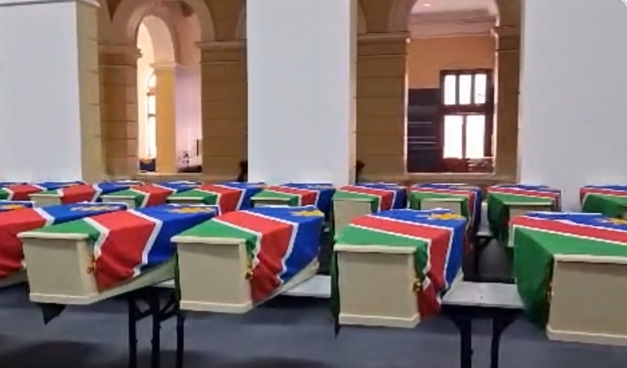
The historic handover took place during a solemn ceremony at the Iziko South African Museum in Cape Town on Wednesday.
The political prisoners, Festus Nehale and Simon Petrus Nilenge, died in captivity during the 1970s after being jailed for their role in the liberation struggle.
Their coffins stood alongside those containing the ancestral remains of 84 indigenous people representing the Ovambo, Himba, San, Nama, Damara, and Herero communities which were unethically collected for colonial race-based scientific research.
“We gather here in Cape Town whose island prison once held these comrades. But we gathered here today to send them home. Today is not an ordinary day. It is a moment in history in which we return mortal remains and cultural objects from the Republic of South Africa to the Republic of Namibia,” said Minister of Sport, Arts and Culture Gayton McKenzie.
The repatriation serves as a vital act of restorative justice, addressing long-standing colonial and apartheid injustices to restore dignity to the deceased and their communities.
🇳🇦🇿🇦 Namibia and South Africa held a historic joint ceremony to repatriate the remains of Namibian freedom fighters Festus Nehale and Simon Petrus Niilenge, who died in colonial custody on Robben Island in 1974.
— Sputnik Africa (@sputnik_africa) August 19, 2026
Hailed by ministers as "dignity restored," the heroes will finally… pic.twitter.com/Y7UmAV9vlC
The freedom fighters will be laid to rest at Namibia’s Heroes’ Acre, whilst the ancestral remains will undergo traditional cultural burial rites upon their return home.
READ NEXT: The forgotten mine workers: 14 years later, and there’s still no justice in the Marikana bloodbath