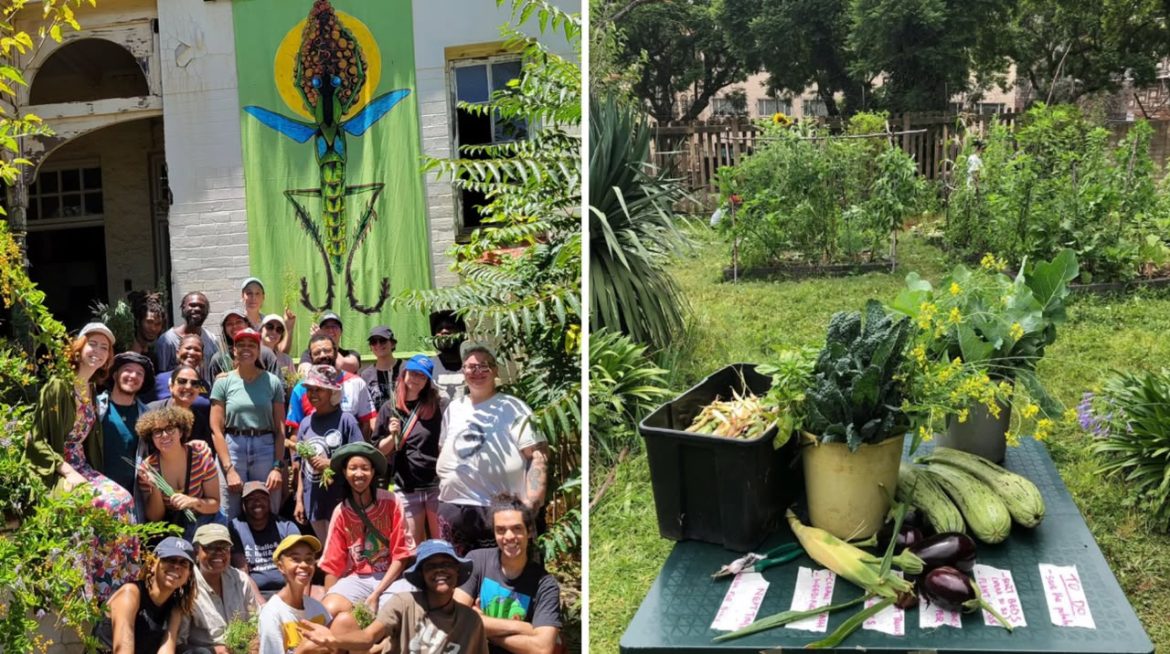

Created during a dark time in South Africa, this community garden in the North of Johannesburg has helped bring the community together and sustain food security.
By Mapaballo Borotho
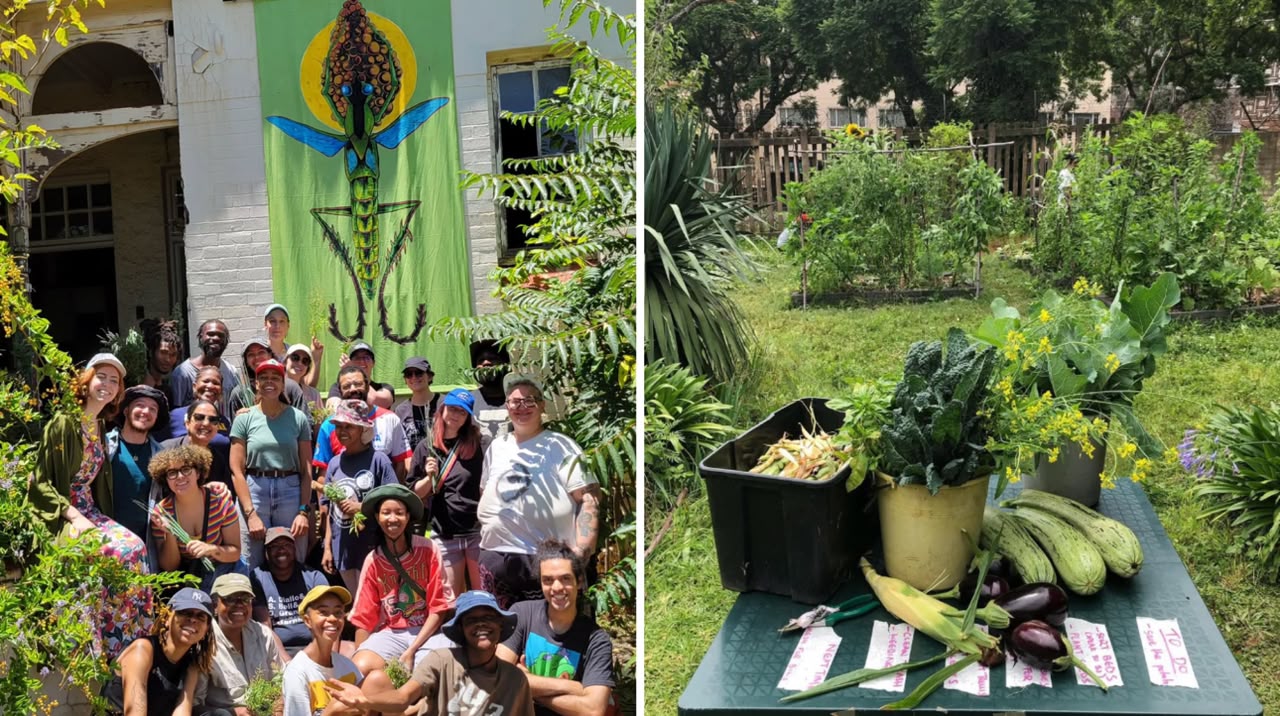
When South Africa went into lockdown in 2020, sisters Molemo and Pelonomi Moiloa realised how little they knew the people living around them. What began as an effort to reconnect with their neighbours and support one another during an uncertain time has since grown into a community initiative rooted in solidarity, shared responsibility, and care.
Together with their loved ones, the siblings established the 12 Park Lane Community Garden in Parktown North, Johannesburg.
The initiative drew on the spirit of community organising that emerged during some of South Africa’s most difficult years, aiming to create a community that could care for and sustain itself during and beyond the COVID-19 pandemic.
The neighbourhood food, herb and medicinal garden started with residents coming together to clear an overgrown and neglected property. Today, it has become more than a space for growing food. It offers neighbours an opportunity to meet, exchange skills, share resources and build relationships with people they might otherwise never have known.
Through gardening, workshops and shared activities, the initiative has helped foster a sense of belonging and collective responsibility among residents from different backgrounds.
Kaya 959 sat down with some of the garden’s co-founders, Molemo Moiloa and Simangliso, to find out more about the inspiration behind the initiative, how it has brought the surrounding community together, the challenges it faces and its vision for the future.
What inspired you to establish the 12 Park Lane Community Garden, and how did the idea first come to life?
“During the 2020 lockdown, a few of us were living in the same building and locked down together – my sister Pelonomi Moiloa, my husband Ben Gapare and two friends, Pandeani Liphosa and Khotso.
We got talking about how little we knew the neighbours in our own building and in the other blocks of flats around us, and how difficult it was to support each other, particularly some of the elderly neighbours who were feeling especially vulnerable in those early lockdown days.
This sense of isolation, and an inability to support each other in a crisis, led us to organise in our neighbourhood. We started with a street clean-up, followed by a programme with the reclaimers’ union, and then the garden.
The community of people who are part of it has changed over time. Simangaliso joined us a few years ago.”
What began as a response to isolation during the pandemic became an opportunity to create a space where neighbours could get to know one another and work towards shared goals.
Your work draws inspiration from South Africa’s history of community organising. Could you tell us more about that?
“We are specifically inspired by the autonomous actions that emerged out of the ungovernable period of 1976 to 1990 in South Africa.
It is a period associated with significant violence and destabilisation, but it is also a period in which communities took on their own power to support their neighbours and enable community security, waste removal and other community needs through street committees and block committees.
We take inspiration from this, rising from crisis to create a community that cares for itself,” Moiloa added.
Why did you choose to create the garden in Parktown North, and what did you hope it would bring to the surrounding community?
“We hoped it would bring the people at the edge of Hillbrow and the people at the edge of Parktown together to create a mutual space that we call ParkBrow. It was not a chosen decision; it is our community.
The neighbourhood is very unusual for Johannesburg. It is a mix of students, low-income housing, higher-income residents and the two hospitals, Brenthurst and Parklane.
This mix doesn’t happen much in Joburg. The GCRO released a report showing that we are one of the more mixed-income neighbourhoods in Johannesburg.
This mix is important to support and facilitate, so that we can imagine other ways of being neighbours in a city like Johannesburg, which still suffers from apartheid-era spatial segregation.
It is also just important to know our neighbours, to be able to call on each other and laugh with each other. Johannesburg doesn’t always make this easy.”
How has the garden evolved since you started, and what have been some of your most memorable milestones along the way?
“We have grown from just planting indigenous crops and learning about food sustainability to hosting workshops with farms and gardens from around the world.
One of the memorable workshops was with Hector from Mexico, who taught us about maize, and Mam Siphiwe Sithole from African Marmalade, who taught us about sorghum.
Hector mapped the history of maize, the etymology of the word and how it should be cooked and prepared to get the best nutrients out of it from an indigenous Mexican perspective.
Mam Siphiwe spoke about how indigenous grains are not well protected and encouraged in South Africa. She also highlighted how we have lost knowledge of many traditional foods and practices that were once deeply connected to our traditional grains”.
How does the garden contribute to food security, and who benefits from the produce or activities it provides?
“We operate on a food-for-work basis, so people who work in the garden share the food that comes out of it.
Anyone can join our open garden days and become part of the garden community. You don’t have to have existing knowledge. We co-learn about indigenous and permaculture models for growing food, which are low-resource, require less water and strengthen the ecosystem.
We also learn about and grow medicinal herbs, especially indigenous plants such as Lengana, Lebake and others.
We teach people to build things such as benches and shade structures, as well as irrigation systems. People have learned to use power tools, basic welding skills and beekeeping, among other things.
We share the produce among fellow gardeners or host cookout events where everyone brings something to share and the garden provides the vegetables.
We believe the surrounding community benefits from these activities because they allow people to meet others from the area or simply learn practical skills, such as building a trellis.”
How do you sustain the project financially and practically, including sourcing seeds, equipment, water and other resources?
“We self-support the garden. We use very low-cost and low-resource gardening methods, including rainwater harvesting. Everyone who works in the garden does so on a voluntary basis.
We have raised donations from neighbours at various points to pay for some of the bigger infrastructure, such as the water-harvesting tank. There is no running water or electricity on the property due to vandalism.
We share seeds with others working in similar spaces. We have squash seeds from a women’s community garden in Morocco, and beans from a powerful woman from Mtubatuba who has been an inspiration to many in indigenous growing methods.
Seed saving and sharing is a political practice. In some parts of the world, big agricultural firms have looked to pressure governments to make certain kinds of seed saving illegal, despite it being an age-old practice among farmers around the world.”
Have you seen a meaningful change in the community since the garden was established? Could you share a particular story or example?
“For some of us, the first time we met people living on the same floor of our building was through these programmes.
Many neighbours have met this way, and it has enabled support around other city-related needs, such as addressing water or electricity outages and even security issues we have faced.
The site itself is also a complex issue. It is a property abandoned by the government in 2010, and together with the neighbours on either side, we have done our best to keep it clean and maintain it to some degree.
In periods when we have been removed from the site, break-ins at neighbouring properties have increased, and drug use on the property has left behind crack pipes and other undesirable materials.”
For the co-founders, the garden’s impact is therefore not limited to what grows on the property. The relationships formed through the initiative have also helped neighbours support one another when facing challenges in their immediate surroundings.
However, maintaining the space has not been without its difficulties, particularly around securing permission to continue operating on the government-owned property.
“We have been kicked out so many times, had to cut and change the chains several times to gain access, and even engaged with NGOs on the best way forward, but have not succeeded. We are still in the process of engaging with the provincial government, and we hope they will respond to our letters,” said Simangaliso.
Moiloa added that the property used for gardening and other activities was abandoned in 2010 and, like many abandoned buildings and properties in Johannesburg, has been badly vandalised.
“The buildings on the property are therefore unsafe. But because it is a heritage building, it is very expensive for the owners to repair.
This has resulted in it being stranded – too expensive to fix but too damaged to be inhabited.
Government has a responsibility not to let people into an unsafe property, but it also has a responsibility to care for buildings it owns, even if it potentially does not have the budget.
It raises a question of how government can better work with civil society and community-based organisations to address issues that affect our communities, such as abandoned properties that encourage vandalism,” she said.
Despite these challenges, the garden remains open to people who want to learn, contribute and become part of the community.
Both Simangaliso and Molemo encourage anyone interested in starting their own food garden, even if it is a small one in their backyard, to attend an open garden day, learn more about the initiative and take some seeds home.
“Gardening is more than growing fruit, vegetables and flowers. It is a therapeutic engagement with the basic natural resources,” added Simangaliso.
The vision is to expand the garden’s activities beyond planting and harvesting, creating opportunities for processing, packaging and exporting produce, while also establishing a space where people can connect and host events.
The long-term goal is to transform the property into a welcoming and sustainable community space where residents can continue to learn, collaborate and build relationships.
The co-founders say the project needs support from the provincial government with administration, the City of Johannesburg to restore essential utilities, and the Department of Agriculture through training and resources.
“We are working on a business plan to have the space function as a sustainable, income-generating community centre and co-working space.
Our models show that an independent and sustainable space that serves the neighbourhood is viable, but it is dependent on a positive dynamic with the provincial government as our landlord and partner.
In the meantime, we welcome partnerships to strengthen our community garden, including materials such as wood, bricks and other building materials, as well as skills in agroecology, food forestry and trades such as woodwork and welding.
We are able to provide a Section 18A certificate in return, which can be submitted to SARS for tax benefits.”
Despite the challenges, the 12 Park Lane Community Garden continues to demonstrate what can happen when people come together with a shared purpose. What began as an effort to overcome isolation during the pandemic has grown into a space where neighbours connect, exchange skills, share resources and take collective responsibility for the place they call home.
For the Moiloa sisters and the people who have become part of the garden, its value goes beyond the food it produces. It is about restoring the spirit of community, reminding people that they do not have to navigate life’s challenges alone, and showing that meaningful change can begin with something as simple as getting to know the person living next door.
In a city where social and spatial divisions continue to shape how people live, 12 Park Lane Community Garden offers a reminder that stronger communities can be built from the ground up – one neighbour, one shared effort and one seed at a time.
READ NEXT: