
As ballot counting gets underway following South Africa’s 2026 Local Government Elections, the South African Police Service is investigating roughly 14 election related offenses while enforcing strict political impartiality among officers nationwide.
By Zuko Komisa
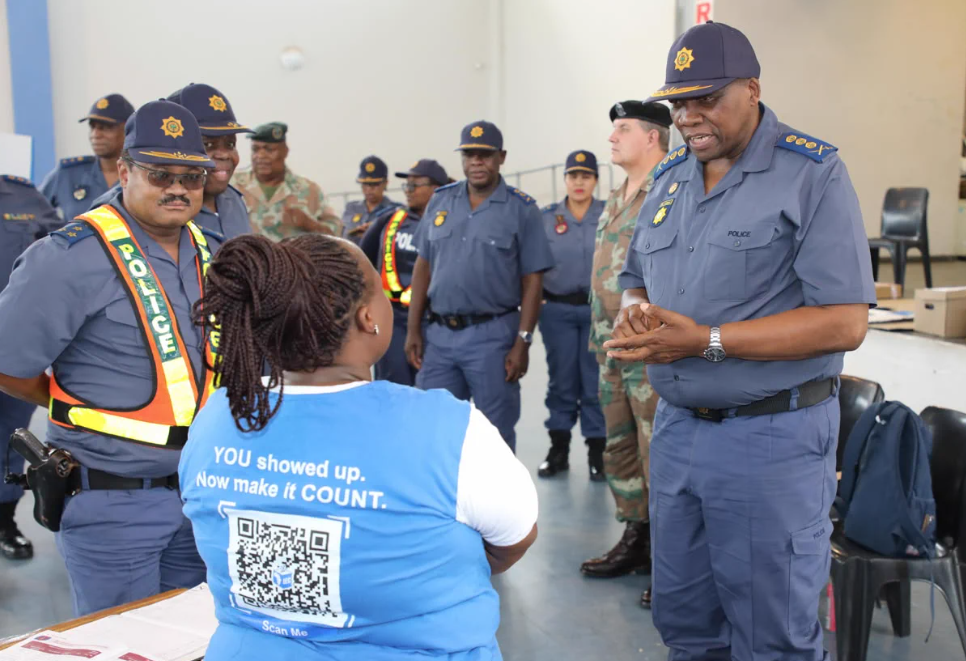
The South African Police Service (SAPS) has opened roughly 14 criminal investigations tied to the 2026 Local Government Elections. The reported offenses range from ballot paper theft and voter intimidation to inter-party clashes and disputes involving campaign posters.
These security measures come as millions of South Africans await the outcome of a pivotal poll. With early vote tallying underway following the close of voting, the maintaining of public order and strict political impartiality among law enforcement remain central to safeguarding the integrity of the country’s local democratic institutions.
National Police Commissioner Fannie Masemola outlined the operational situation upon arriving at the Electoral Commission of South Africa (IEC) Results Operations Centre in Midrand. Speaking to journalists during a doorstep interview,
Masemola confirmed that recent incidents predominantly involve election-related misconduct.
“Since yesterday, most of the cases are related to the elections either theft of ballot papers and intimidation, or fighting where there is intolerance among political party members,” he said.
Police are simultaneously investigating several serious crimes, including murders recorded in KwaZulu-Natal and the Eastern Cape. Officers have flagged specific hotspots requiring heightened monitoring, notably parts of eThekwini and uMkhanyakude in KwaZulu-Natal, alongside designated areas in the Eastern and Western Cape.
Despite these localized disruptions, Masemola emphasized that voting has remained broadly peaceful nationwide, supported by responsive security measures. In one instance, police successfully dispersed a community water protest in the Amathole District Municipality to allow polling stations to resume operations.
While respecting the public’s right to demonstrate, the Commissioner stressed that civic grievances must not impede the democratic process.
Addressing force conduct, Masemola reiterated the strict requirement for neutrality among officers. While police personnel retain the personal right to vote, he underscored that officers are strictly forbidden from wearing political party regalia while on duty, as doing so can “compromise the perception of impartiality”.
READ NEXT: